
You have done everything right on paper. The store looks polished. The products are strong. You are spending consistently. And yet, month after month, the numbers stay flat. Before assuming the problem is your product or your ads, it is worth asking a harder question: do you actually know where the problem lives? Most merchants do not, and that missing layer of Shopify store diagnosis is what quietly keeps capable stores stuck.
Working hard on the wrong things
There is a pattern that plays out across Shopify stores every month. A founder notices things slowing down: checkout completions are stuck, repeat buyers are fewer than expected, and the momentum that once felt natural has disappeared. So they do what any capable operator would do. They get to work.
New product photos. Tighter copy. A homepage redesign. A CRO freelancer for a month. Each decision feels logical. Each one should work.
Three months later, the store is in the same place.
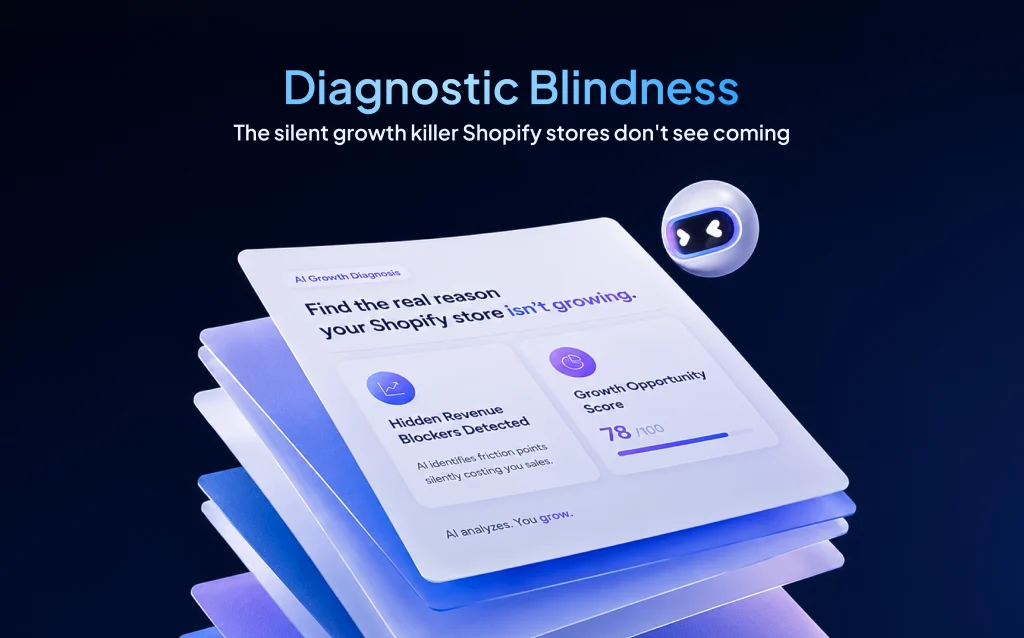
This is not a motivation problem. It is not a product problem. It is something called diagnostic blindness, and it is quietly holding back more Shopify stores than almost anything else in 2026.
What diagnostic blindness actually means
Diagnostic blindness is not a lack of data. Most Shopify merchants have the opposite problem: too much of it. Session counts, add-to-cart rates, checkout abandonment percentages, scroll depth, email click rates. The numbers are all there.
The blindness is in what those numbers cannot tell you. There is a gap between knowing that something is not working and understanding why it is not working, and that gap is where revenue quietly disappears.
A merchant can see that 68% of visitors leave their product page without buying. That is a real number. What they cannot see is the reason behind it. Is the shipping cost only appearing at the final checkout step? Is the add-to-cart button not loading correctly on certain phones? Is a slow-running app quietly making the page feel broken before the shopper even gets to consider buying?
Each of those causes has a completely different fix. Without knowing which one applies, every change you make is essentially a guess.
Why this becomes so costly, so quietly
The damage of diagnostic blindness is that it never announces itself. A store stuck at 1.6% conversion is not obviously broken. It is just not growing. And because you are always doing something, testing a layout, swapping a creative, or adjusting targeting, it never feels like stagnation. It feels like progress that somehow never arrives.
Meanwhile, the actual friction in your store keeps doing its job. Every week it goes unaddressed, the same number of interested shoppers pass through, and fewer of them convert than should. That compounds over months into real lost revenue, with no obvious signal pointing to the cause.
Three ways merchants misread their own stores
1. They treat symptoms as causes.
A drop in checkout completion triggers a redesign of the checkout page. But what if the real problem is happening earlier, on the product page, or even in how the pricing is presented? The redesign treats the visible symptom. The actual cause goes completely untouched.
2. They optimise what is measurable, not what matters.
Most analytics tools report on what is easy to count: sessions, clicks, revenue. What they do not show is where a shopper hesitated, what created a moment of doubt, or which element on the page triggered the exit. Those behavioural signals are often the real drivers of drop-off, and they do not appear in any standard dashboard.
3. They have too many tools pointing in too many directions.
The average scaling Shopify store runs 20 to 35 apps at once. Each generates its own data. None of them produce a coherent picture of what is actually happening across the whole store. The merchant ends up with several partial truths and no reliable diagnosis.
The gap no dashboard was built to close
Standard analytics tools were built to show you what happened. They do that well. What they were never designed to do is explain the mechanism behind the numbers or tell you which specific variable is suppressing your growth.
Sweor's research found that 88% of shoppers are less likely to return to a store after a poor experience, yet most Shopify merchants have no reliable way to detect where that experience is breaking down inside their own storefront. They can see the outcome. They cannot see the cause.
That is the gap diagnostic blindness creates. And it is the reason capable, hardworking merchants can spend months improving a store that does not improve.
When you stop reporting and start advising: what QQQE does differently
This is exactly the problem QQQE was built to solve.
QQQE connects to your Shopify store and runs an AI-powered diagnostic across key areas of your business, including customers, products, pricing, and promotions. It identifies revenue-impacting issues and opportunities, ranking them by severity so you know what deserves attention first.
What makes QQQE different is its benchmark-driven approach. Rather than looking at your store in isolation, QQQE evaluates performance against relevant benchmarks and identifies the gaps that may be limiting growth. This helps merchants understand not only what is happening but also where the biggest opportunities exist.
From there, QQQE highlights Quick Wins: practical recommendations based on your store's performance gaps and business priorities. Instead of overwhelming you with reports and dashboards, it focuses on actions that can have the greatest impact.
Where a traditional analytics tool might tell you that 68% of visitors leave a product page, QQQE helps you understand where drop-offs occur, what factors may be contributing to them, and what actions to consider first.
That is the difference between reporting data and guiding decisions.
Closing thought
The Shopify stores that break through plateaus in 2026 will not be the ones running the most experiments or reviewing the most dashboards. They will be the ones that see clearly, that understand their store's full picture and know, with confidence, which friction is costing them the most and what to change first.
If your store has felt stuck despite genuine effort, the answer to why it is not growing almost certainly is not what you have been fixing. It lives in the gap between the numbers you can see and the reasons you cannot.
That gap has a name. And now, it has a solution.
Find out where your store's growth is actually stalling.
QQQE analyses your Shopify store and tells you what is creating friction, what is suppressing conversions, and what to prioritise so your next decision is the right one.
Install on Shopify App Store → Explore QQQE
Frequently asked questions
Q.1 What is 'diagnostic blindness' in ecommerce?
It is the condition where a merchant has access to performance data but cannot accurately identify the actual source of their growth problem. They can see that something is underperforming; they simply cannot see why, which leads to fixing the wrong variables while the real friction goes unresolved.
Q.2 Why do Shopify stores plateau even when the merchant is actively improving?
Because most improvements target visible symptoms rather than root causes. When the actual source of friction – an app conflict, a trust gap, a checkout step creating decision fatigue, is never identified, no amount of creative or structural optimisation will move the underlying metric.
Q.3 How is AI growth analysis different from Shopify's built-in analytics?
Shopify's native analytics reports what happened: sessions, sales, and conversion rate. AI growth analysis explains the mechanism behind those numbers: where friction occurs, why users exit, which specific elements are suppressing conversion, and which fix matters most by revenue impact.
Q.4 What causes hidden conversion friction in a Shopify store?
The most common sources are app conflicts that create rendering issues on certain devices, missing trust signals on product pages, checkout flows with surprise costs, and page weight caused by accumulated app scripts, none of which appear clearly in standard reporting.
Q.5 How does QQQE help Shopify merchants identify growth problems?
QQQE performs deep website analysis on a Shopify store to identify where conversion friction exists, what is driving behavioural drop-off, and which fixes carry the highest revenue impact, turning raw store signals into prioritised, actionable direction rather than just more metrics to monitor.