
You run more ads. You send a discount. You try a flash sale. Sales pick up for a few days, and then they fall flat again. So you repeat the whole thing.
If that sounds familiar, you are not alone. Most Shopify store owners are stuck in this loop, not because they are doing anything wrong, but because they are only pulling one lever when there are actually four.
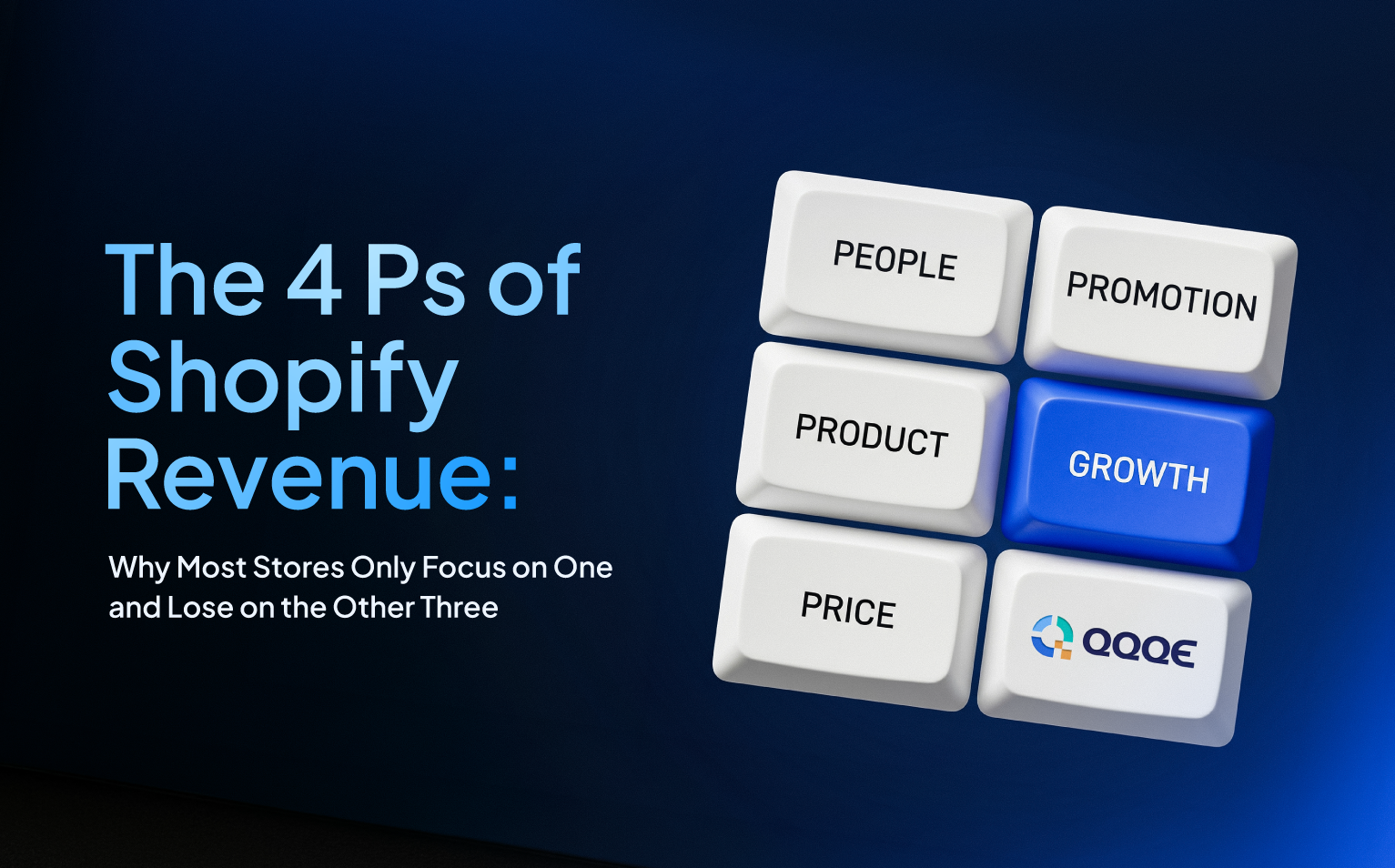
The 4 Ps revenue framework says that every Shopify store runs on four things: People, Product, Price, and Promotion. Each one affects your revenue. Each one can quietly undo the progress you make in the others. Most stores spend almost all their energy on Promotion. The other three go untouched, and that is usually where the real problem lives.
Why Your Revenue Problem Is Probably Not About Traffic
When sales slow down, the first thing most merchants check is traffic. Not enough visitors, right? So they spend more on ads.
But more traffic only helps if your store can turn visitors into buyers, keep them coming back, and price orders profitably. If those three things are off, more traffic just means more people leaving without buying.
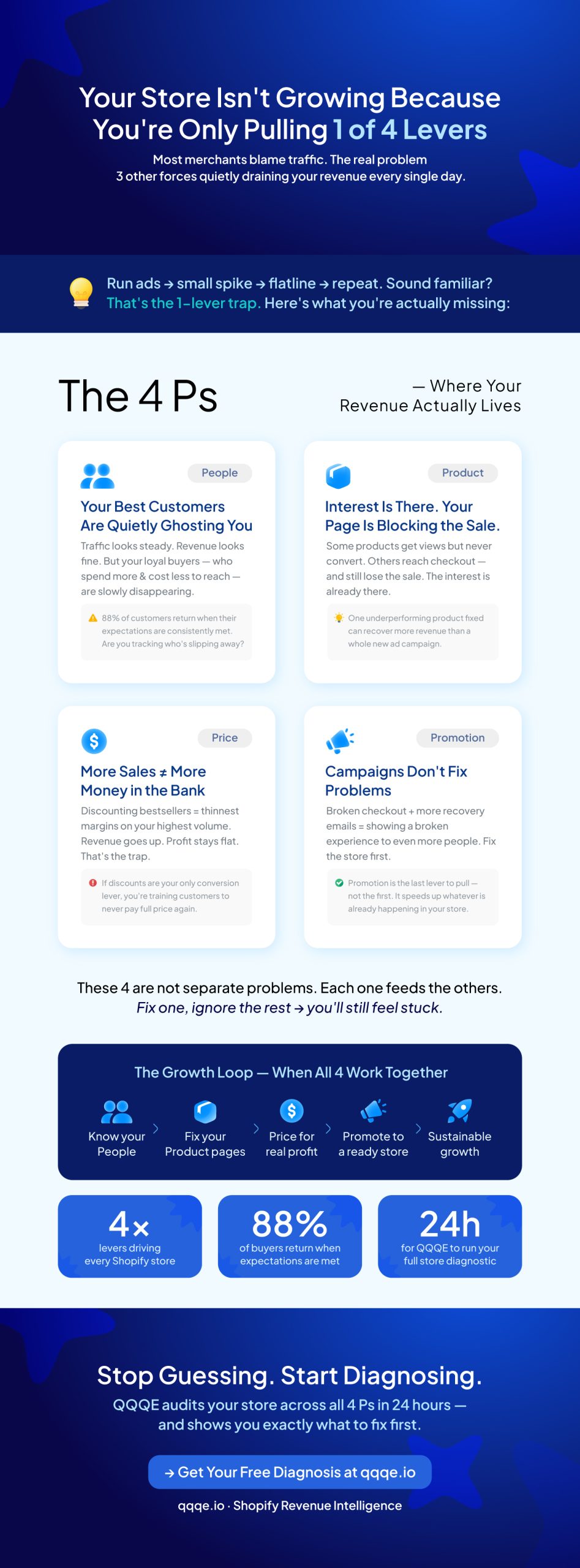
That is what the 4 Ps are really about: People (who comes back and who leaves), Product (whether what you sell matches what people want), Price (whether you make real profit, not just sales), and Promotion (whether your campaigns work on a store that is ready for them).
These four things connect to each other. Fix one and ignore the rest, and you will still feel stuck.
Product: People Want to Buy, but Your Store Is Getting in the Way
Here is something that surprises a lot of merchants: you can have healthy traffic and still have a serious product problem.
Some products attract a lot of views but almost no purchases. Some make it to the checkout stage regularly, but shoppers still walk away. Others have never sold a single unit since you added them. Your overall numbers can look fine on the surface while specific products quietly drag your conversion rate down.
When a shopper keeps coming back to look at the same product but never buys it, that is real buying interest being wasted. Something is creating hesitation. But you cannot begin to find out what until you first know which products have this pattern and how widespread it actually is.
The fix starts with knowing which products have this problem. One underperforming product with genuine demand can recover more revenue than a new ad campaign. The interest is already there. Remove whatever is blocking the sale, and the next question becomes: are those buyers actually coming back?
People: Your Best Customers Might Be Quietly Walking Away
People are the one area most merchants ignore, and it is the one that quietly costs the most.
It covers a lot more than basic traffic: how many customers come back for a second purchase, whether your highest-spending customers have gone quiet, what time of day your store gets the most visitors, and how many repeat visitors actually convert into buyers.
That last one matters more than most people realise. A store can have perfectly steady traffic while losing its best customers in the background. Your new customer numbers look fine. Your revenue chart looks stable. But your loyal buyers, the ones who spend more, cost less to reach, and buy more often, are slowly disappearing. And by the time it shows up in your revenue, a large chunk of them are already gone.
This is why keeping customers matters as much as finding new ones. Yet most store owners spend nearly all their budget on acquisition. The loyal buyers who go quiet barely get noticed. And the reason many leave often comes down to the next P: Price.
Price: Growing Revenue Is Pointless If You Are Not Making a Profit
Here is a hard truth: revenue and profit are not the same thing.
A store can show growing sales every month and still be losing money. This happens most often through discounting. It starts as a one-off promotion to move slow stock. Then it becomes a regular thing. Then it becomes the only way to get people to buy.
The problem is that your best-selling products usually have the thinnest margins, because those are the ones you discount most. So the products driving the most volume are also draining the most profit per sale. Revenue goes up. The bank account does not.
There is another angle that most merchants never check. Customers often abandon products in one specific price range more than others. High-priced items get left at checkout because buyers feel uncertain about the value. Low-priced items get skipped because they feel non-essential. Knowing which price bracket is causing the most drop-off, and why, tells you exactly where to focus instead of guessing.
That kind of pricing clarity is also what determines whether Promotion, the fourth P, is actually worth running.
Promotion: More Campaigns Only Amplify What Is Already There
Promotion covers everything you use to reach customers and drive action: emails, discounts, flash sales, bundle offers, checkout recovery, and on-site pop-ups. It is the most visible lever, so it is always the first one merchants pull. But it is also the easiest one to waste money on.
Promotion does not change what is happening in your store. It speeds it up. If your checkout has friction, more recovery emails just highlight a broken process to more people. If your best customers already buy regularly, a blanket discount wastes margin on buyers who were going to convert anyway. If your product pages are unclear, a flash sale brings more visitors who still will not add to cart.
A checkout recovery email targeting yesterday's abandoned customers, with the exact products they left behind, works completely differently from a discount sent to your whole list. One addresses a specific, known problem. The other is a guess dressed up as a campaign.
Without clarity on your People, Product, and Price first, every promotion you run is just amplifying a problem you have not found yet.
Why All Four Have to Work Together
Each P feeds the others. Wrong pricing pushes loyal buyers away. Weak product pages make promotions fail. Not knowing your returning customers means you cannot build campaigns that keep them.
Pull only one lever and the other three limit how far it goes. Sustainable growth comes from keeping all four in check together, not as separate projects on different months.
How QQQE Diagnoses Revenue Problems Across the 4 Ps
QQQE exists to close exactly this gap. During onboarding, a merchant selects their market segment and the metrics that matter most, such as churn rate, AOV, repeat visitor rate, abandoned checkouts, etc. From there, QQQE connects to the store's product, customer, and order data, runs a full diagnostic within 24 hours, and benchmarks the results against similar stores in the same category.
QQQE then organises the output along People, Product, Price, and Promotion, so a merchant sees where each dimension stands instead of one blended score. Each issue becomes a structured problem statement: a plain-language description of what's happening; a severity level of Critical, Medium, or Minor; and a small set of ready-to-launch solutions, rather than a vague suggestion to "improve conversion".
Alongside the full diagnostic, a Quick Wins engine continuously ranks the highest-impact, lowest-effort opportunities, so merchants always know what to act on first. When a merchant chooses to act, campaign activation runs through guided steps, not a manual process. Merchants set targeting, discount limits, device and location filters, and email or pop-up delivery, all in one flow, while merchant-set discount thresholds protect margin automatically. Every active campaign also feeds back into performance analytics tracking AOV, lifetime value, conversion rate, and returning customer rate, while the entire diagnostic re-runs every seven days to keep insights current.
Final Thoughts
Most Shopify stores don't actually have a traffic problem. They have a visibility problem: a gap between what's really happening across People, Product, Price, and Promotion, and what shows up on a single revenue chart. Once that gap closes, growth stops being a guessing game and becomes a sequence of clear, prioritised decisions.
Flat revenue is hard to explain through traffic numbers alone, which is exactly why it's worth checking what the other three Ps are doing. QQQE runs that full diagnosis automatically and shows exactly where to start.
FAQ Section
Q.1 Why is my Shopify store not converting visitors into sales?
Low conversion is rarely a traffic problem. It usually points to a Product issue like a catalog mismatch, a People issue like low trust, or a Price issue like checkout friction.
Q.2 Why is my Shopify revenue flat even though traffic stays steady?
Steady traffic with flat revenue usually means churn, low retention, or pricing friction is quietly cancelling out the gains from that traffic.
Q.3 How do I know if discounting is hurting my profit margin?
If average order value is rising but margin isn't, frequent discounts on bestsellers are usually the cause. Track margin alongside revenue, not just sales totals, to see the real picture.
Q.4 What does QQQE do for Shopify stores?
QQQE connects to a store's product, customer, and order data, then runs a diagnostic within 24 hours that benchmarks performance against similar stores across People, Product, Price, and Promotion.
Q.5 What is a Quick Win in QQQE?
A Quick Win is a high-impact, low-effort opportunity that QQQE automatically ranks above other findings, so merchants always know what to fix first.